




How to reach
Cennina can be reached from Florence following the Motorway A1 up to the exit ' Valdarno'. From Montevarchi following the indications for Bucine and, passed the country, those for Siena along the SS540. After around two kilometers we find on the right the road, signalled, for Cennina.
History
The castle rises on a hill of 477 meters high at dominion of the Valdambra, that was in the Middle Age an important road of communications between the Florentine territory of the Upper Valdarno and the Valley of Monteaperti under Senese control, and strategic access to Florence from south. Its origin goes back, with every probability, to the Etruscan-Roman era and its development to the time of the Longobard invasions, perhaps as point of lookout and control on the underlying roads. The actual walled suburb rises around the feudal castle of the 12th century.
The castle was built in 1167 by the count Brandaglia Alberigo d' Uguccione to whose family belonged during all the 12th century, although the zone resulted under the control of the counts of the Guidi family, and subsequently the castle changed several feudal owner: Cennina was occupied by the Tarlati, Ubertini and the counts Guidi themselves.
The Valdambra, of which Cennina was the most important and strategical settlement, was at the borders between the territories of Florence, Arezzo and Siena, and the castle was besieged, destroyed and reconstructed many times, always involved in the wars between the Guelphs Florence and the Ghibellines Siena and Arezzo. In the 1307 Cennina was damaged by the Senese army, allied with the Black Guelphs of Florence that were in war against the White Guelphs allied with the Ghibellines of Arezzo
In 1360, after alternate circumstances, Cennina become part of the Florentine territory, that established here its strengthened outpost to control the valley. After almost one century, in 1447, Cennina suffered a terrible siege from the Aragonesi army, allied with Siena. Despite the hard resistance the castle was conquered, but after only fifteen days it was regained and strengthened.The last military occupation of the castle happened in 1529, by the army of the prince of Orange on the road through the Valdambra to Florence .
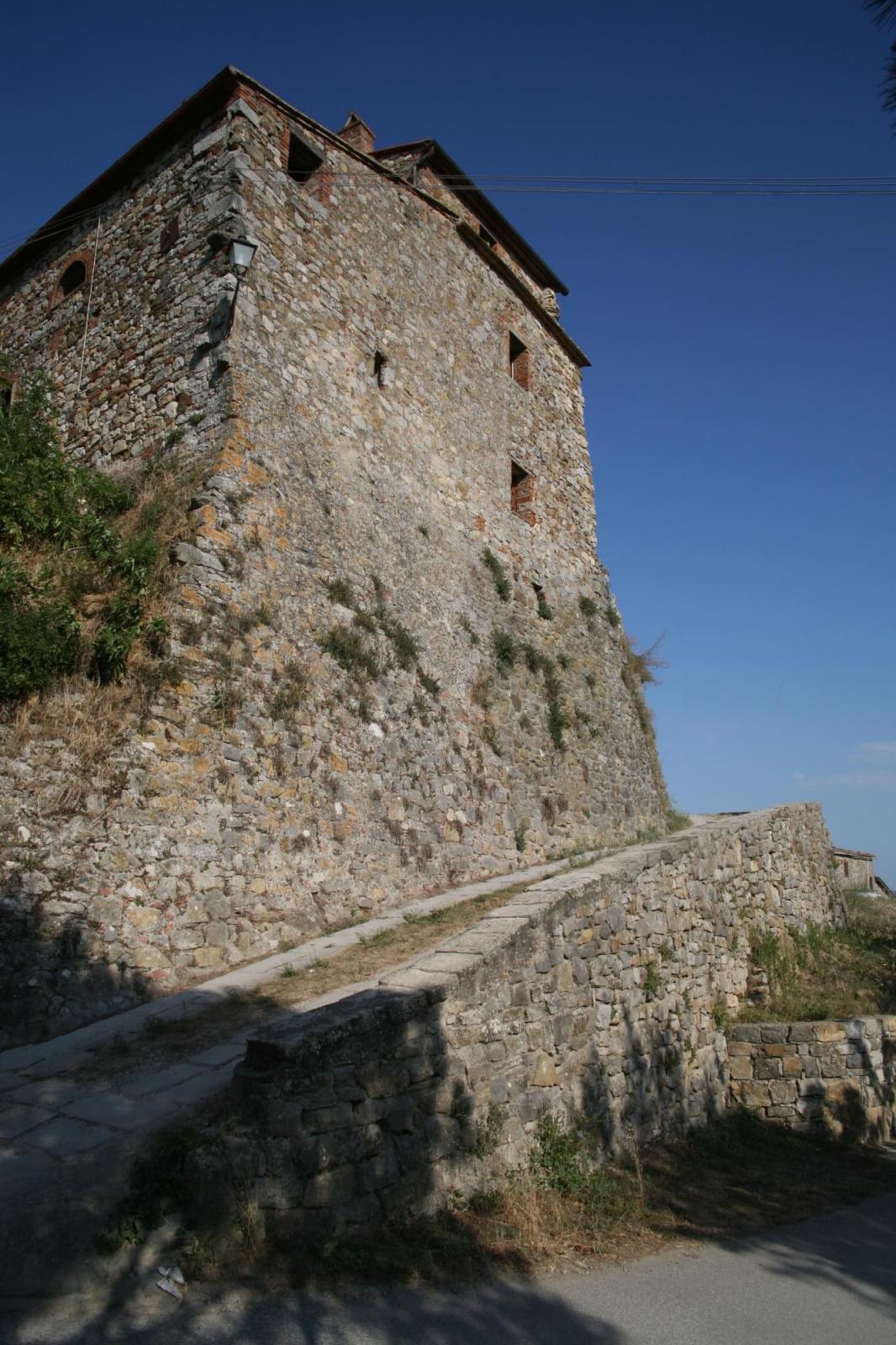
Cennina, enclosed by the rests of imposing walls of notable thickness and consistence, it is one of the main testimoniance of fortification in the Valdambra. On the ruins soars the mighty rectangular Keep with the beautiful main gate to access the inside courtyard, still with a well at the center, around which different rural houses have risen, almost all erect in the last centuries using the stones of the castle. On the right of the beautiful inner ward rises the rests of the feudal Palace, residence of the constable, restored and turned to private residence.
The original perimeter of the courtain walls is still well visible: on the side of north-east they are practically intact, to southwest we can notice the collapsed angle tower, now abandoned on the ground. From its ruins we can deduce that it was square and open on the side facing the courtyard, as the oriental tower of the near Rocca of Civitella in Val of Chiana.